Secondment 1
Reseacher: Alejandro Del Pozo Lira (University of Talca, CHILE)
Secondment to: Agrobiotechnology Institute, IdAB-CSIC, SPAIN
Host supervisor: Dr. Iker Aranjuelo
Period: from 22nd March 2022 until 30th June 2022
Training activity:
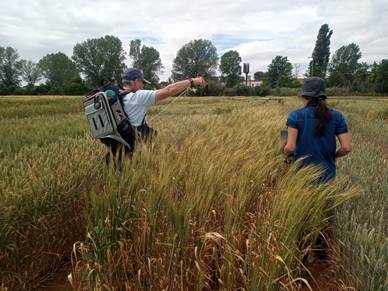
While working with Dr. Iker Arajuelo at Idab-CSIC, I conducted measurements of leaf and canopy reflectance using a spectroradiometer (FieldSpec 4 HiRes, ASD Inc., Boulder, CO, USA). These measurements were performed on field-grown wheat genotypes, in collaboration with Ph.D. student Angie Gámez. The obtained spectral signatures, ranging from 350 to 2500 nm, were then correlated with various leaf photosynthetic, canopy, and agronomical traits using three multivariate regression techniques, namely Lasso, elastic net, and PLS.
Furthermore, we have prepared a supplementary proposal for the Agency of Research and Development, Chile, which complements the Marie Skłodowska-Curie Actions (MSCA). The proposal, titled «Accelerating Crop Breeding and Adaptation to Drought-Prone Environments through High-Throughput Field Phenotyping,» has secured financial support of EUR750,000 for a duration of three years (2023-2025). Under this new project, our focus will be on developing field phenotyping protocols and employing remote sensing technologies to identify characteristics associated with the performance of bread and durum wheat, as well as quinoa, in environments susceptible to drought. Additionally, we will conduct genomic studies and dissect the genetics of relevant quantitative traits, specifically those connected to crop performance and grain quality in drought-prone conditions.
Secondment 2
Reseacher: Alejandro Del Pozo Lira (University of Talca, CHILE)
Secondment to: University of Reading (Reading, UK)
Host supervisor: Dr. John Hammond
Period: from 10th July 2022 until 10th August 2022
Training activity:
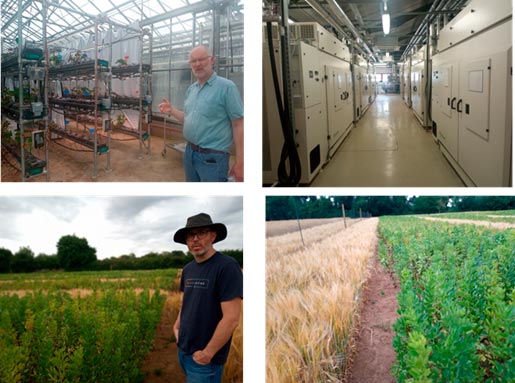
At the School of Agriculture, Policy, and Development, I had the opportunity to collaborate with Prof. John Hammond and Prof. Paul Hadley. Together, we exchanged knowledge and insights regarding plant phenotyping in both controlled environments and field settings. As part of my contribution, I delivered a presentation entitled » Enhancing crop adaptation to drought-prone environments through high-throughput field phenotyping and genomic studies» to the members of the School.
Furthermore, I had the opportunity to visit Sonning Farm to observe field experiments focused on legume-cereal intercropping, which were led by Prof. Hammond. This particular research on intercropping aligns with the interests of our research group as we have been studying nitrogen fixation by legume crops and the transfer of nitrogen to wheat. Our objective is to contribute to the development of more sustainable production systems.
Secondment 3
Reseacher: David Soba (Agrobiotechnology Institute, IdAB-CSIC, SPAIN)
Secondment to: Auburn University (Auburn, USA)
Host supervisor: Dr. Alvaro Sanz-Saez
Period: from 09th May 2022 until 8th July 2022
Trainig activity:
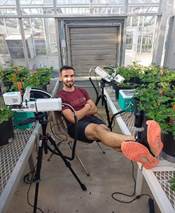
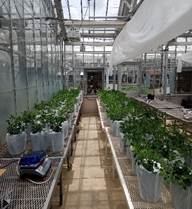
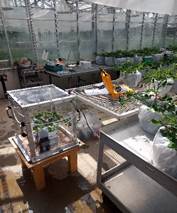
David Soba during his stay at Auburn University, under the supervision of Dr. Alvaro Sanz-Saez, carried out an experiment with 9 different peanut cultivars under controlled conditions to evaluate their transpiration rates and identify variations in tolerance mechanisms to the drought.
Throughout the research process, Dr. Soba collected data on plant growth, transpiration rates, water use efficiency, gas exchange, and other relevant physiological parameters. He analyzed and interpreted the data to draw conclusions about the mechanisms of drought tolerance in groundnut cultivars.
These experiments will help to understand how different peanut cultivars respond to drought stress and to identify the specific physiological characteristics associated with drought tolerance.
Secondment 4
Reseacher: Garazi Ezpeleta (Agrobiotechnology Institute, IdAB-CSIC, SPAIN)
Secondment to: University of Talca (Talca, Chile)
Host Supervisor: Prof. Alejandro del Pozo Lira
Period: from 05th September 2022 until 26th Novemeber 2022
Trainig activity:
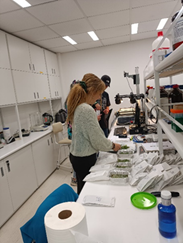
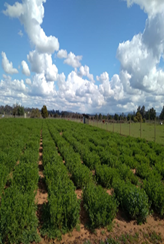
During the stay in Talca (September-November 2022) we analyzed alfalfa varieties grown in the Cauquenes population (INIA experimental center). The plots were divided into control and drought, of one square meter each, with a total of 1,000 plots.
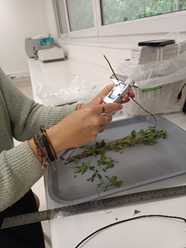
There were two samplings in the field: In the first, the plants were cut and the fresh and dry weight was calculated. In the second, fresh samples were collected to be able to measure the length and width of the stem and, finally, the leaf area.
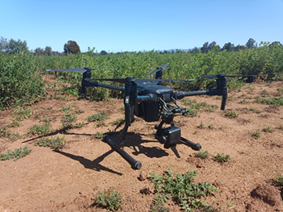
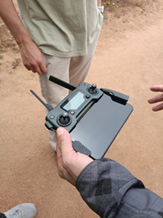
We also carried out analysis of images taken with two different drones, they had an RGB and multispectral camera.
Coordinator: iker.aranjuelo@csic.es